
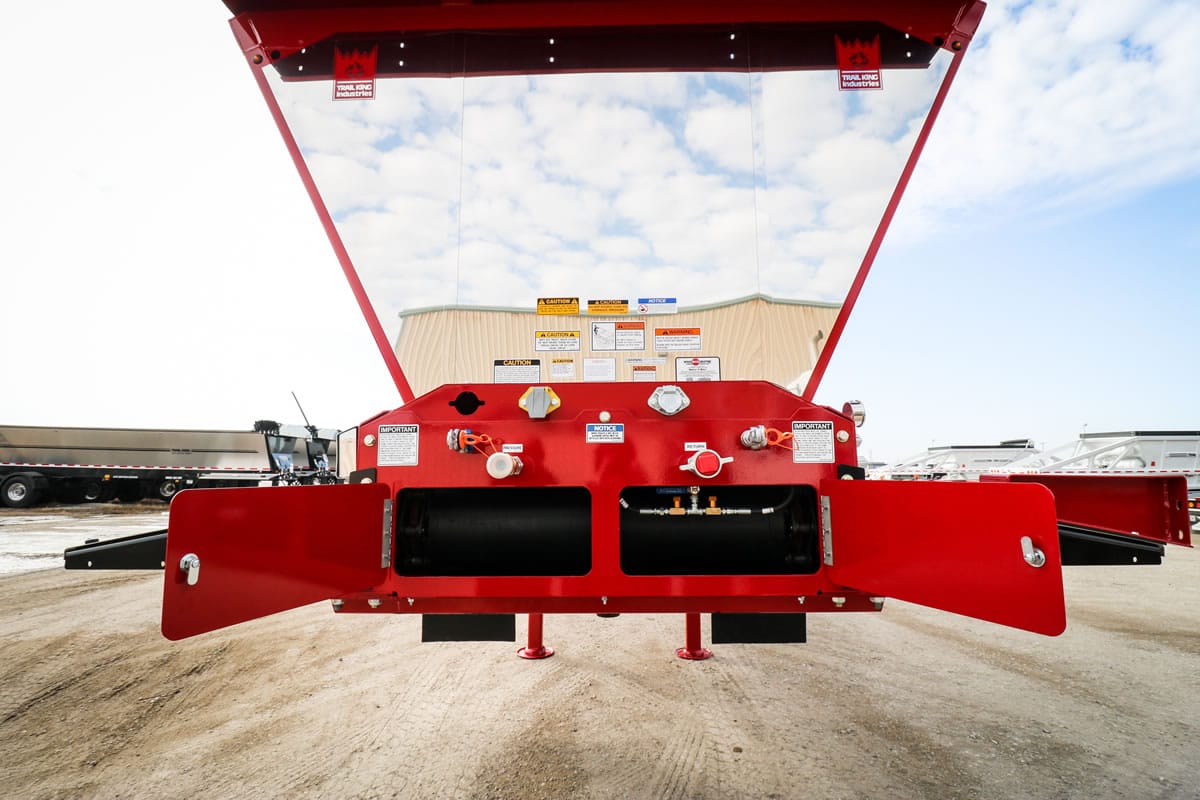
At Trail King, we understand that moving bulk materials efficiently requires more than choosing a trailer based on capacity alone. The way you unload material can affect productivity, stability, jobsite access, and uptime.
The main difference between a live bottom and an end dump trailer is how they unload material. A live bottom uses a conveyor system to move material horizontally toward the rear of the trailer, while an end dump raises its body so gravity moves the material out the rear. Understanding how each unloading system performs in different operating conditions can help contractors, fleet managers, and owner-operators choose the right equipment for their needs.
Understanding the Difference Between Live Bottom and End Dump Trailers
Live bottom trailers hold material in a fixed hopper. A hydraulic conveyor at the bottom moves the material to the back of the trailer for unloading.
Traditional end dump trailers work differently. The trailer body lifts up, letting gravity move the material to the discharge point.
Both types are useful for hauling bulk material. The best choice depends on what you haul, where you unload, and the conditions your drivers face.
| Feature | Live Bottom Trailer | End Dump Trailer |
| Unloading method | Horizontal conveyor discharge | Raised body and gravity discharge |
| Trailer body during unloading | Remains in its normal position | Raises during unloading |
| Overhead clearance | Generally requires less overhead clearance during unloading | Requires additional overhead clearance |
| Ground conditions | Useful where raising the body is impractical | Requires appropriate ground and unloading conditions |
| Material flow | Controlled, continuous discharge | Gravity-based discharge |
| Common applications | Asphalt, asphalt millings, road base and other bulk materials | Bulk materials where conventional dumping fits the jobsite |
| Key consideration | Controlled unloading and operating clearance | Simple gravity unloading and available dumping space |
How Unloading Systems Affect Jobsite Efficiency
Unloading is a major consideration when comparing trailer designs.
A live bottom conveyor lets operators control how fast material is unloaded and stop the process when needed. This steady, horizontal unloading is helpful when you need a constant flow or when lifting the trailer body is not practical.
End dump trailers use a simple gravity-based unloading process. But since the body must be raised, operators need enough space and solid ground before unloading.
If you haul frequently, consider how each unloading method affects cycle times, truck positioning, material placement, and the amount of space required at the jobsite. A trailer that fits your loading and unloading process can help create a more consistent workflow across repeated hauling cycles.
Stability and Overhead Clearance Matter
Jobsite conditions can make the physical differences between these trailer types even more important.
Because a live bottom unloads horizontally without raising the trailer body, it can be advantageous in applications where overhead clearance or the ability to raise a trailer body is a concern. Operators should still evaluate ground conditions, site layout, load characteristics, and applicable safety requirements before unloading.
But no single trailer design is right for every job. Operators should look at ground conditions, unloading space, overhead clearance, and safety needs before choosing equipment.
Match the Trailer to the Material You Haul
The type of material you haul should also be part of your decision.
Depending on the configuration, live bottom trailers can be used to haul bulk materials such as hot-mix asphalt, asphalt millings, road base, and other construction materials. Trail King’s live bottom lineup is designed for efficient horizontal discharge and multiple axle configurations to accommodate different hauling requirements. Their controlled discharge is helpful when you need to manage how fast material comes out.
Think about what you haul now and what you might need to haul in the future. Choosing equipment that fits your usual jobs gives your fleet more flexibility.
Consider Your Jobsite and Hauling Frequency
Before you buy either type, consider the whole hauling process from start to finish.
Think about where the trailer will usually unload. Is the ground flat and stable? Are there overhead obstacles? How much space does the driver have to move? How often will the trailer load and unload each shift?
If your fleet often works in tight spaces or places with overhead limits, horizontal unloading may be more valuable. Other operations might prefer a traditional end dump trailer if it fits their usual workflow.
The best choice is to match your equipment to your real operating conditions, not just one feature.
When Should You Choose a Live Bottom Trailer?
A live bottom trailer may make sense when your operation benefits from controlled horizontal unloading and the ability to discharge material without raising the trailer body. It can be particularly useful when overhead clearance, unloading space, or material placement are important considerations.
A live bottom can also be worth considering for operations that frequently haul materials such as asphalt and need a consistent, controlled discharge. The right configuration depends on the material, required capacity, axle configuration, road conditions, and jobsite requirements.
Choosing the Right Trailer for Your Operation
Choosing between a live bottom and an end dump trailer means weighing material type, unloading needs, jobsite conditions, how often you haul, productivity, and long-term value.
Maintenance should also factor into the decision. Live bottom trailers include mechanical and hydraulic components associated with their conveyor system, while end dump trailers rely on their own hydraulic lifting and dumping components. Consider accessibility, service requirements, parts availability, and your fleet’s maintenance capabilities when evaluating long-term operating costs.
Trail King offers a full line of materials-hauling trailers, including the TKLB Live Bottom, TKLBH Heavy Live Bottom, TKBD Bottom Dump, and TKSSD Steel Side Dump. The TKLB and TKLBH live bottom models are designed for horizontal discharge, with multiple configurations available for different payload and hauling requirements.
Frequently Asked Questions
What Is a Live Bottom Trailer?
A live bottom trailer has two main parts: a stationary hopper that holds the material during transport, and a conveyor that unloads the material horizontally.
How Does a Live Bottom Trailer Work?
A hydraulic conveyor sits at the bottom of the hopper. As it turns, it moves material to the back, where it is unloaded through the rear door.
What Are the Advantages of a Live Bottom Trailer?
Live bottoms allow drivers and ground crew members to control conveyor speed. This allows operators to control the material unloading speed and stop unloading if needed.
What Materials Can a Live Bottom Trailer Haul?
Depending on how it is set up, a live bottom can haul materials like hot-mix asphalt, asphalt millings, and road base.
Is a Live Bottom Safer Than an End Dump Trailer?
A live bottom can offer operational advantages in situations where raising a trailer body is impractical, such as jobsites with limited overhead clearance. However, no trailer should be considered inherently safe for every unloading condition. Operators should evaluate ground conditions, site layout, overhead clearance, load characteristics, and manufacturer recommendations before unloading.
What Type of Trailer Is Best for Hauling Asphalt?
There is no one-size-fits-all answer. If you need controlled horizontal unloading, easy maneuvering, and efficient unloading, a live bottom trailer can be a great choice.
Final Thoughts
Choosing between a live bottom and an end dump trailer depends on how and where you work. Think about material type, unloading space, terrain, clearance, how often you use the trailer, and your productivity goals.
Knowing the strengths of each unloading system helps you pick equipment that moves material efficiently and meets your jobsite needs.
Explore Trail King’s material hauling trailers and discover a solution engineered to keep material moving efficiently from the road to the jobsite.