
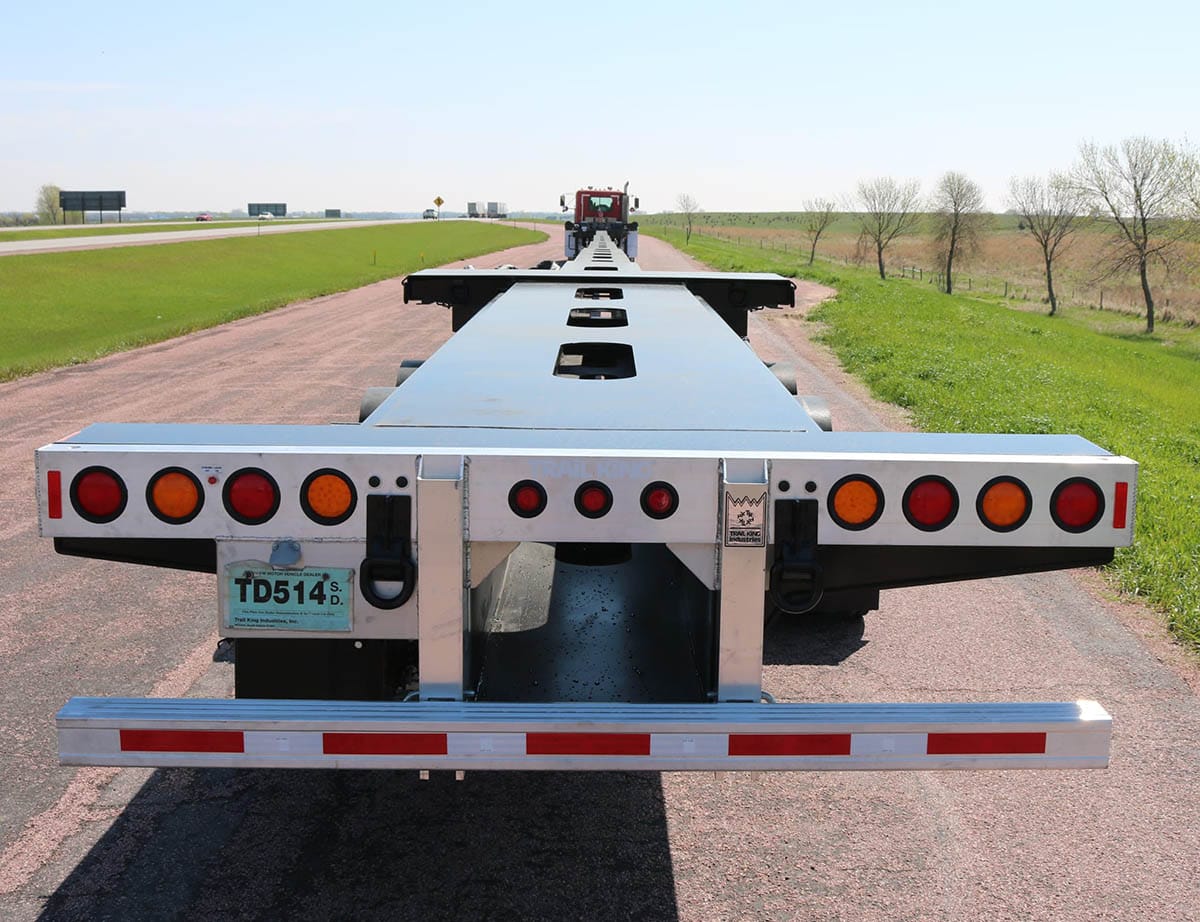
At Trail King, we understand that compliance goes beyond avoiding tickets. It protects your crew, equipment and business. For fleet managers, owner-operators and safety officers, knowing trailer requirements is essential to prevent downtime and ensure efficient operations.
Whether hauling locally or across state lines, the right setup ensures your trailer passes inspection and avoids delays.
The “Will I Get a Ticket?” View
The primary concern for every operator is whether the setup will pass inspection. Federal and state regulations require trailers to meet standards for lighting, braking, visibility and load securement. Noncompliance can result in citations, fines or being placed out of service.
Key compliance factors include:
- Functioning brake lights, turn signals and
- Proper reflectors and visibility markings
- A braking system for trailers above certain weight thresholds
- Secure coupling systems and safety chains
Heavier trailers and commercial units are subject to stricter requirements, particularly under DOT and FMCSA regulations.
The “Is It Secure?” View: Safety & Load Protection
Improperly secured cargo is a leading cause of accidents and violations. Shifting loads can damage equipment, cause instability or spill onto roadways.
To stay compliant and safe, your trailer must include:
- Proper tie-down systems such as chains, binders or straps
- Adequate anchor points built into the trailer
- Load containment systems, such as tarps or covers for loose materials
For material hauling trailers, proper coverage is especially important. Loose debris without coverage can result in immediate violations.
Trailer Registration, Documentation & Legal Requirements
Every commercial trailer must be properly registered and display a valid license plate. In most cases, documentation must include:
- Proof of ownership
- Registration paperwork
- Visible and illuminated license plates
Failure to meet these requirements may result in fines or impoundment in some jurisdictions.
For commercial operators, documentation also extends to:
- Inspection records
- Maintenance logs
- Compliance with federal transportation standards
Weight Thresholds & Axle Rules
Weight is a critical compliance factor.
Each trailer has a Gross Vehicle Weight Rating (GVWR), the maximum total weight specified by the manufacturer. Exceeding this rating increases the risk of:
- Brake failure
- Tire blowouts
- Structural damage
Exceeding the GVWR also violates transportation laws and legal weight limits.
Many states require a braking system (a device that slows or stops a vehicle) once a trailer exceeds a certain weight, typically between 1,000 and 3,000 pounds.
Proper axle distribution is also essential for safe operation and legal compliance in commercial hauling.
Trailer Width & Oversize Regulations
Trailer width is a common compliance factor.
Trailers wider than 80 inches require additional safety features, such as:
- Clearance lights
- Side marker lights
- Additional reflectors
Oversized loads may require additional permits and escorts, depending on the state and route.
Failure to comply can result in immediate shutdowns during roadside inspections.
The “Cross-Country Hauler” Reality
Interstate travel introduces additional compliance challenges. Each state has different rules regarding:
- Brake requirements
- Lighting standards
- Licensing and permits Legal requirements vary by
To avoid disruptions, meet or exceed the most restrictive requirements along your route.
High Visibility Requirements: Lights, Tape & Reflectors
Visibility is essential for compliance and safety. Federal standards require:
- Rear red reflectors
- Side amber reflectors
- Conspicuity tape for larger trailers
Reflective tape reduces nighttime collisions by improving trailer visibility.
Trail King material hauling trailers are designed for optimal visibility. Moisture-resistant lighting systems and high-visibility tape placement help ensure trailers remain visible in low-light environments, including quarries, paving sites and night operations.
The Tarping Rule: Load Containment
For material hauling, tarping is not optional. It is a legal requirement in many areas.
Loose materials such as gravel, asphalt or debris must be contained to prevent spillage. This is where equipment design matters.
Trail King trailers feature integrated tarp systems and secure anchor points, making compliance easier and improving operational efficiency.
Underride Protection & Rear Impact Safety
Rear impact protection is a critical requirement.
Trailers must include reinforced rear structures designed to:
- Prevent smaller vehicles from sliding
- Absorb impact forces
- Meet DOT safety
Trail King bottom dump models feature heavy-duty rear structures that meet or exceed these requirements and maintain operational functionality.
Trailer Brake Systems For Safety & Control
Brake systems are among the most critical compliance components. Common systems include:
- Electric braking systems for controlled stopping
- Hydraulic systems that activate during deceleration
Trailers equipped with brakes must also have a breakaway system, which automatically engages the trailer’s brakes if it becomes disconnected from the towing vehicle.
Trail King offers configurations that support both reliability and performance by:
- Reduce maintenance costs
- Improve stopping control
- Enhance safety during heavy braking
Why Compliance Is a Competitive Advantage
Many operators overlook a key reality.
Compliance does more than prevent penalties. It increases productivity by reducing downtime and maintenance costs, and helps you meet legal and operational demands efficiently.
Trailers that are not properly equipped:
- Fail inspections
- Experience more downtime
- Increase maintenance costs
Trail King material hauling trailers are designed to meet DOT trailer regulations. Many features that are optional with other manufacturers come standard, helping operators:
- Stay road-ready
- Reduce risk
- Improve long-term performance
Own A Trailer Built To Drive Productivity and Performance
Equipment required by law often differs from equipment needed for efficient operations. A smart trailer design bridges this gap.
For example:
- Proper braking systems improve safety and reduce
- Visibility features reduce risk in active job
- Load containment systems speed up
The right trailer does more than pass inspection; it helps your operation run faster, safer and more efficiently.
Understanding trailer equipment requirements isn’t only about compliance; it protects your business, your team and your bottom line.
Properly equipped trailers help you avoid shutdowns, reduce risk and maintain efficient operations.
Explore Trail King’s material hauling trailers, built for compliance. With standard safety features and durable designs, Trail King helps you stay compliant, productive and on the road.